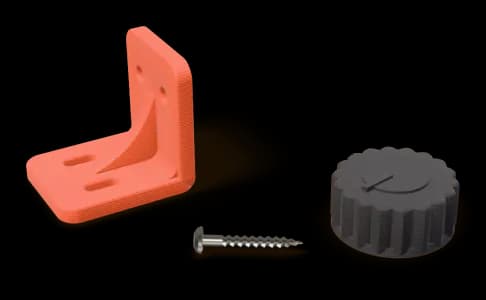
A clip snapped on a drawer, a knob cracked on an appliance, a bracket nobody sells any more. Many broken plastic parts can be reprinted with FDM, often in a tougher material than the original. This guide covers the whole path: getting a file, choosing the material, getting the fit right, and knowing when 3D printing is not the answer.
1. First, get a 3D model of the part
We print from a 3D file (STL, 3MF or OBJ), so the part has to exist as a model first. In order of effort:
- Search for it. Model libraries such as Printables, MakerWorld and Thingiverse hold many replacement parts for common products. Search the product name and model number together with the part’s name.
- Model it yourself. Most replacement parts are simple shapes — a bracket, a spacer, a clip. Measure the original with a calliper (a ruler is not accurate enough for anything that has to fit) and draw it in a free tool such as Tinkercad, Onshape or FreeCAD.
- Have it modelled. A freelance designer can work from your measurements and photos. Ask for STL or 3MF in millimetres.
Before anything is thrown away, photograph the broken part from several sides and keep the pieces: the fracture often shows exactly where the original was too weak. Phone scanning apps are fine for decorative shapes but are usually not accurate enough for a part that must fit something else. Our guide for people without a 3D file goes into each option.
2. Measure what has to fit, not everything
On a replacement part only a few dimensions really matter: the holes a screw goes through, the width of the slot it clips into, the face it sits against. Measure those twice and write them down. Everything else can be approximate.
Remember that FDM typically holds around ±0.5 mm on ordinary geometry (see 3D printing tolerances). For a sliding or push fit, a rule of thumb is to start from 0.2–0.3 mm diametral clearance and adjust after a test print. Small threads are more reliable as a heat-set insert or a nut than as printed thread.
3. Choose the material for where the part lives
- PETG — the usual choice for household replacement parts. Tougher and less brittle than PLA, and copes with warmth and moisture.
- ASA — outdoors, in the sun, or on the outside of a car.
- PA (nylon) and carbon-fibre nylon — for parts that wear, carry load or get warm. Carbon-fibre grades are stiffer but more brittle; use them where the problem is bending, not knocks.
- TPU — for feet, bumpers, seals and anything that should flex.
- PLA — fine for indoor parts that see no heat or load, and for a cheap test print to check the fit.
PLA vs PETG: which filament? and Engineering filaments go further.
4. Think about which way it breaks
A printed part is strongest along its layers and weakest between them. If the original broke at a thin neck or a clip, that feature should not end up loaded across the layers. The part is printed the way your file is oriented, so lay the model out so that feature is loaded along the layers; our guide to orientation and strength explains why. Where you can, thicken the section that broke — you are not bound by the original’s moulding limits.
5. Print one, try it, then order the rest
The most reliable way to get a replacement part right is one test print. Order a single part, try the fit, adjust the model, and only then order more or switch to the final material. It is usually cheaper than getting the second attempt wrong too.
When 3D printing is not the right answer
Some parts should not be replaced by a print, or at least not without an engineer’s judgement: parts near high heat (an engine bay, a heater element), parts under constant pressure or heavy sustained load, and anything whose failure could hurt somebody — brakes, steering, lifting gear, child safety products. We do not produce certified parts for food contact or medical use. Whether a part is fit for its job is your decision; we print exactly the file you send, and we are happy to talk it through if you are unsure — write to us.
Ready to price it?
Upload the file to the instant quote: the price appears straight away, and you can compare PETG, ASA and nylon on the same part before deciding. More examples of what people reprint are on the spare and replacement parts page.