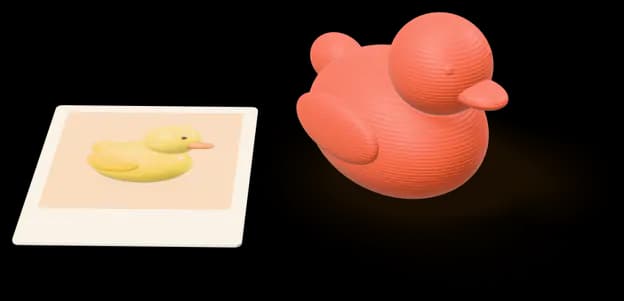
You have a photo of an object — a figurine, an ornament, a pet, a keepsake — and no 3D file. Our paid Photo to 3D service turns one photo into a printable 3D model that you can size and order like any other part. It works well for some things and not for others, and it is worth knowing which before you pay.
How it works
- You upload one photo of one object, confirm you have the right to use it, and pay the per-model fee shown on the page.
- An AI model builds the 3D shape from the photo. We then make it printable: one solid body, stray fragments removed, holes closed where possible, and a flat base so it stands on the build plate.
- You choose the size on a live 3D preview — by height, width or depth — and see the price for exactly that size.
- You order it like any uploaded part, in the material and colour you choose.
Generating a model needs an account. If a generation fails — the provider refuses the photo, or the result cannot be made printable — the fee is refunded automatically; you are not charged for a model you did not get. The service is not offered in every country yet; the page tells you if it is unavailable for your account.
What makes a good photo
- One object, on its own, filling most of the frame.
- A plain, contrasting background.
- Soft, even light — no hard shadows or bright reflections.
- The whole object in view, seen slightly from above, nothing cut off.
- Sharp, not blurred; a phone photo is fine.
The model can only be as good as the photo it is made from.
What it cannot know
One photo shows one side. The back, the underside and anything hidden behind something else are inferred — a plausible guess, not a copy. The result follows the photo closely but is an interpretation, especially on the faces the camera could not see. Very fine detail, thin protruding parts and small lettering are the first things to soften or disappear.
The preview shows the photo’s colours, but the print is single-colour, in the material and colour you choose. If you want several colours, ask for a custom quote.
What it is good for — and what it is not
- Good: figurines, busts, ornaments, sculptural gifts, toys and decorative objects, where the overall shape matters more than exact dimensions.
- Not good: anything that has to fit something else — a replacement part, a bracket, a case. The AI does not know real dimensions, so measure the part and model it instead (see 3D printed replacement parts).
- Not allowed: photos you do not have the right to use, protected designs, or people who have not agreed to be reproduced.
Alternatives worth considering
If the object is a common product or character, a ready-made model from a library such as Printables or MakerWorld may be more accurate and free. If you need exact dimensions, several views or a likeness that has to be right, a 3D designer working from several photos will do better than any single-photo method. Our guide for people without a 3D file covers each route.
Try it
The fee, the steps and photo examples are on the Photo to 3D page. If you already have a file, go straight to the instant quote.